Busan
Korea's second city and its great port — looser, warmer and more southern than Seoul, with mountains behind it and beaches inside the city limits.
Photo: Basile Morin, CC BY-SA 4.0, via Wikimedia Commons
Busan sprawls along the south-east coast, wedged between mountains and the sea, with the harbour at its centre and the beaches strung out to the east. It is Korea's largest port and second-largest city, and it feels notably different from Seoul: lower, looser, warmer, and more interested in seafood than in almost anything else.
The beaches
Haeundae is the famous one — a long crescent of sand backed by high-rise hotels, packed in July and August, pleasant and half-empty in May. Gwangalli, a bay to the west, is the one locals prefer: smaller, ringed with bars and cafés, and facing the Gwangan bridge, which is lit at night and is the reason to eat there rather than at Haeundae.
Jagalchi and the fish
Jagalchi is Korea's largest fish market and the clearest expression of what this city is. The ground floor is the market proper — tanks, ice, and vendors who have been there for decades. Upstairs, restaurants cook whatever you have just bought downstairs.
Nearby, the covered lanes of Gukje market and the street-food stalls of BIFF square handle the rest of the eating. Busan's food is its own tradition: dwaeji gukbap, the pork-broth rice soup that is effectively the city dish, and milmyeon, its wheat-noodle answer to the cold noodles of the north.
Gamcheon
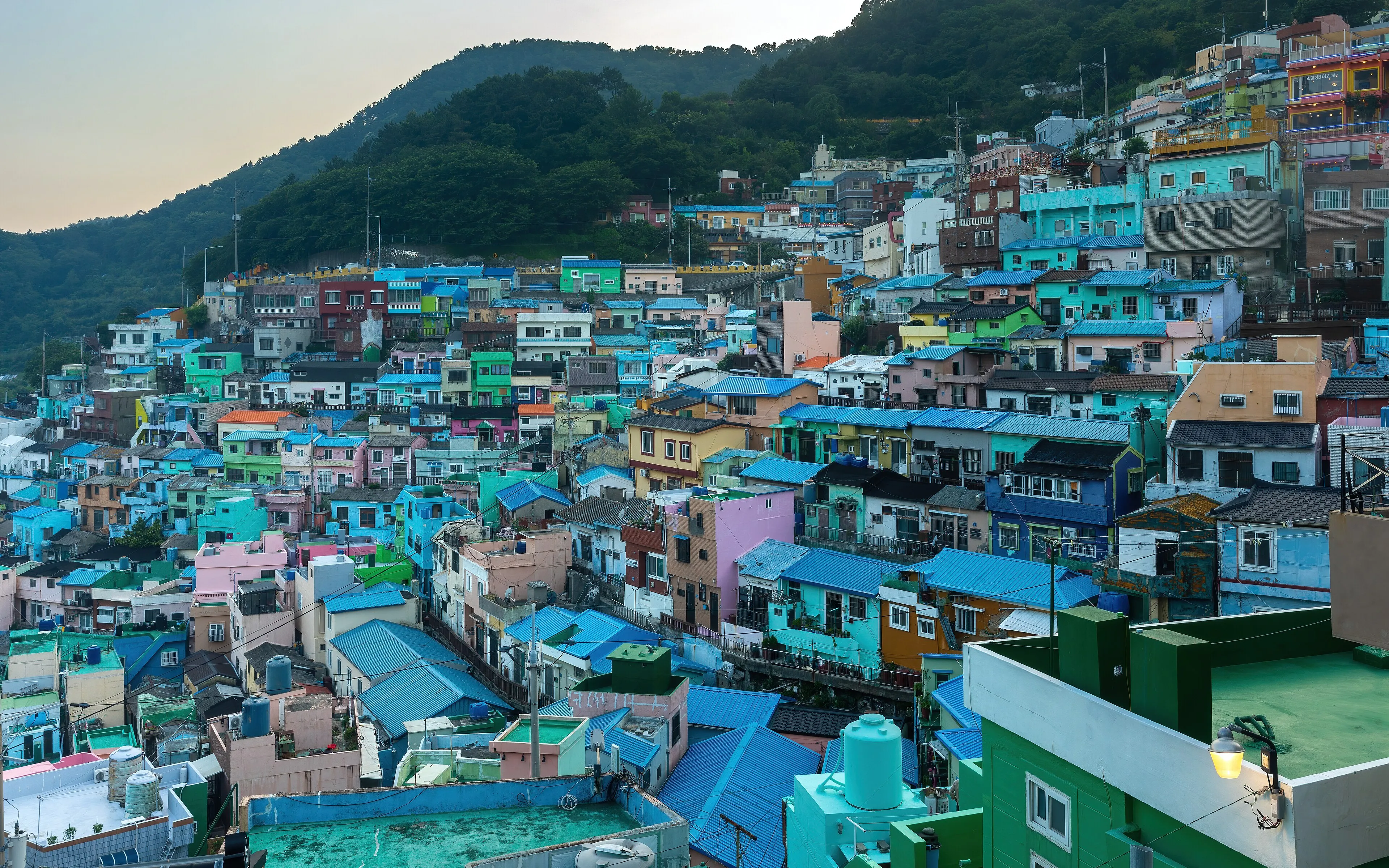
A hillside of small houses painted in blocks of colour, stacked in tiers above a valley on the west side of the city. It was a refugee settlement during the Korean War and was later turned into an art project; it is now one of the most photographed places in the country.
Go early. It is a residential neighbourhood as well as an attraction, and the people who live there have to get past the visitors.
Temples
Beomeosa sits in the forest on the slopes of Geumjeongsan, north of the city — a working mountain temple, and one of the major Zen monasteries of Korean Buddhism. Haedong Yonggungsa is the opposite: a temple built onto the rocks at the edge of the sea, on the coast east of the city, with waves below the shrine halls.
Between them they cover both of Busan's registers, the mountain and the water.
Getting around and moving on
Busan has its own subway, and the same transit card works here as in Seoul. The city is long and thin, so journeys take longer than the map suggests — allow for it.
From here, Gyeongju's royal tombs are an hour or so away by bus, ferries run to Japan and to the southern islands, and the KTX goes back to Seoul in under three hours. See getting around Korea for the options.
Common questions
How do I get to Busan from Seoul?
By KTX, in under three hours from Seoul Station to Busan Station. It is one of the easiest intercity journeys in Asia and there is little reason to fly.
How long should I stay?
Two nights is enough for the beaches, the fish market and Gamcheon. Three or four lets you add the temples, a day on the coastal walk, and time to eat properly — which in Busan is the point.
When is the best time to visit?
Late spring and early autumn. Busan is milder than Seoul year-round, but the beaches only really work in high summer, which is also when the whole country descends on them.