Korean etiquette
Korean etiquette runs on one organising idea: relative age and status. Almost every custom below is that idea applied to a situation, which makes the whole system easier to remember than a list of rules.
Korean social life is organised around seniority in a way that has no close equivalent in most western countries. Age, position and the length of a relationship determine how people speak to each other — literally, since the verb endings change — and how they sit, pour, greet and eat.
As a visitor you sit outside the system, which means the stakes are low. Nobody is scoring you. But the customs below are noticed when you get them right, and a few of them are worth genuine attention.
Greetings
A nod of the head is the everyday greeting, deepening slightly with the seniority of the other person. Handshakes are common in business, often with the left hand supporting the right forearm — a gesture of respect that is worth copying.
Names come with titles attached far more often than in English, and Koreans will frequently address each other by role rather than by given name. If someone introduces themselves with a title, use it.
The two-handed rule
Give and receive with two hands: money, cards, business cards, cups, gifts, anything passed to someone older or in a position of authority. If one hand is occupied, support the giving forearm with the other.
This is the single easiest habit to adopt and the one that most reliably registers as good manners.
Shoes
Shoes come off at the threshold of homes, temple halls, hanok guesthouses and any restaurant with floor seating. The transition point is usually obvious — a raised step, a change of flooring, a shoe rack. Slippers are often provided; a separate pair usually waits by the bathroom.
At the table
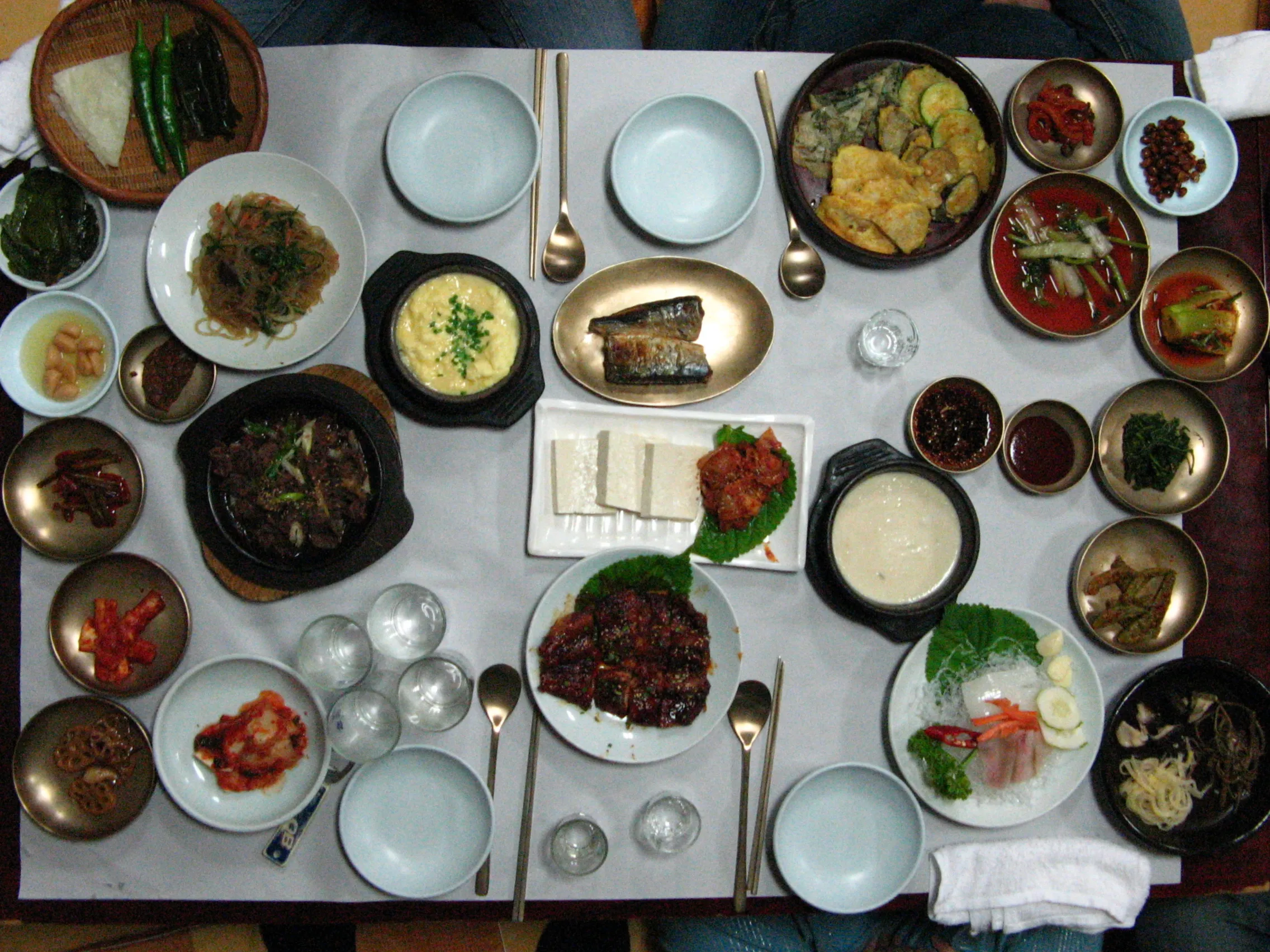
The oldest person at the table starts. Rice and soup sit in front of you, everything else is shared from the middle, and the array of small side dishes — banchan — is refilled without charge.
Use the spoon for rice and soup, chopsticks for everything else, and do not hold both at once. Do not lift the rice bowl to your mouth, which is normal in Japan and not here. And never leave chopsticks standing in the rice.
Drinking
Drinking is where Korean hierarchy is most visible. You do not pour your own glass — someone else fills yours and you fill theirs, watching to top up a neighbour's glass before it empties. Both hands on the bottle when pouring for someone senior; both hands on the glass when receiving.
When drinking with someone notably older, it is customary to turn your head slightly away as you sip. Declining a drink outright is possible but takes a little social skill; accepting the pour and sipping slowly is the easier path.
What this section covers next
Greetings and restaurant behaviour each get their own guide, currently in writing. The language section covers the verbal half of the same subject — including why the grammar itself encodes all of this.
More guides on the way
These pages are being written right now. They will appear here as soon as they are published.
- Greetings
- At the restaurant
Common questions
Do I need to bow?
A small nod of the head covers almost every situation a visitor meets. Deep bows are for formal occasions and significant seniority. Nobody expects choreography from a foreign guest.
What is the worst thing I could do at a Korean table?
Standing your chopsticks upright in a bowl of rice — it echoes an offering to the dead. Beyond that, starting to eat before the oldest person at the table is the misstep Koreans actually notice.
Should I take my shoes off?
Indoors at homes, in temples, in hanok guesthouses, in traditional floor-seating restaurants, and anywhere you see a raised threshold and a rack of shoes. When in doubt, watch what everyone else did.