The Korean language
Two hours with the alphabet will change how the country looks to you. Signs stop being decoration and start being words, most of which turn out to be food.
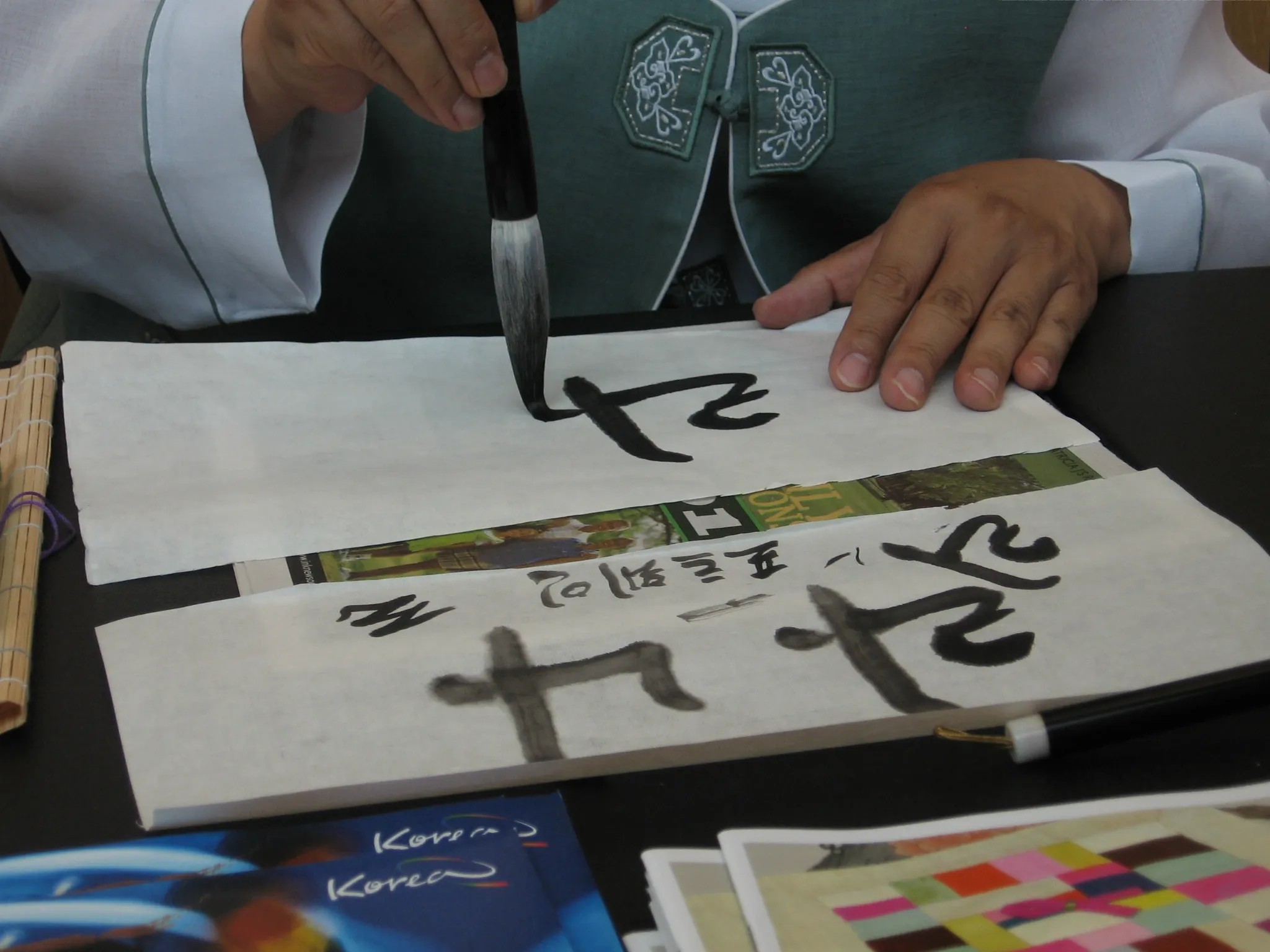
Korean is not related to Chinese or Japanese in the way people often assume. Its vocabulary borrows heavily from Chinese, much as English borrows from Latin, but the grammar is its own: verbs at the end, particles marking the role of each word, and a system of speech levels that changes the ending of nearly every sentence according to who you are talking to.
That last part is what makes Korean hard to speak well. It is not what makes it hard to read.
Hangul, and why it is different
Most writing systems evolved. Hangul was designed — commissioned in the fifteenth century under King Sejong, explicitly so that ordinary people could become literate without years of study in Chinese characters.
It has twenty-four basic letters. The consonants are drawn from the shape the mouth makes to produce them; the vowels are built from three strokes representing heaven, earth and humanity. Letters are then stacked into square syllable blocks rather than written in a line, which is why Korean text looks denser than an alphabet has any right to.
The design goal was that a person could learn it in a morning. It broadly holds. This is the rare case where the traditional claim and the traveller's experience agree.
What reading actually gets you
Sounding out a sign is not the same as understanding it — but in Korea it is closer than you would expect, because a large share of the words a visitor needs are borrowed from English and simply written in hangul. Coffee, bus, taxi, cheese, ice cream, hotel, card. Once the letters resolve, a surprising number of signs decode themselves.
The rest is pattern recognition: station names, the words for "entrance" and "exit", the handful of characters that mean a place serves noodles.
What to speak
A short list carries a traveller a long way: hello, thank you, excuse me, please give me this, how much, delicious, and the numbers. Korean has two number systems used in different contexts, which is the one piece of grammar worth meeting early because you will use both on the same day.
Pronunciation matters less than most people fear. Effort is received warmly, and a mangled attempt in Korean lands better than a fluent sentence in English.
Where the rest of the section goes
This part of the site breaks into the alphabet itself — letter by letter, with the sounds — and a practical phrasebook organised by situation rather than by grammar. Both are being written now. In the meantime, the etiquette section covers the non-verbal half of the same problem, which in Korea is at least as large.
More guides on the way
These pages are being written right now. They will appear here as soon as they are published.
- Korean alphabet
- Useful phrases
Common questions
Do I need to learn Korean to visit?
No. Transport, major sights and most city restaurants handle English. But the gap between zero Korean and a little is larger here than in many countries, because so much everyday signage is hangul-only.
What is the single most useful thing to learn?
The alphabet. Not phrases — the alphabet. Being able to sound out a word lets you recognise loanwords, read menus, match a station name to a map, and use a dictionary at all.
Is romanised Korean reliable?
Only partly. Korea has used more than one romanisation system, and older spellings survive on signs and in place names. The same syllable can appear several ways, which is another argument for reading the original.