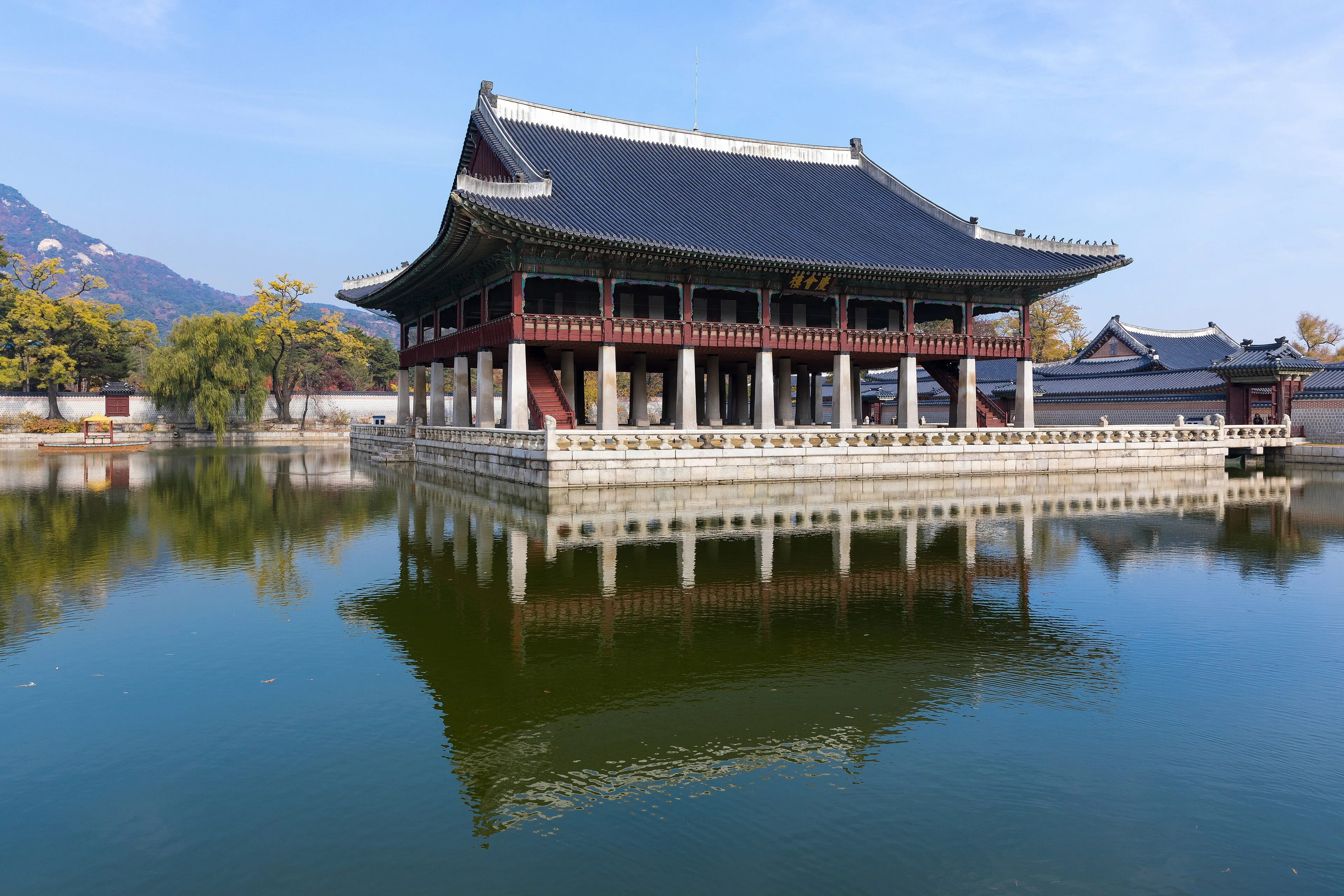
Seoul
A capital of around ten million people that still runs on walkable neighbourhoods, each with its own character — and a palace complex from 1395 sitting in the middle of it.
Photo: Frank Schulenburg, CC BY-SA 4.0, via Wikimedia Commons
Seoul is not one city so much as a collection of districts that happen to share a subway map. Twenty-five of them officially, each a gu, and the difference between two adjacent ones can be the difference between a Joseon-era alley and a street of glass towers.
That is the thing to plan around. Rather than a list of sights spread across the map, pick districts and give each one an afternoon.
The palaces
Five royal palaces survive from the Joseon dynasty, clustered in the historic north of the city between Gyeongbokgung and the mountains behind it.
Gyeongbokgung is the largest and the most visited, with a ceremonial changing of the guard at the main gate. Changdeokgung, a short walk east, is the one most people end up preferring: less formal, better preserved, and attached to the Huwon or "Secret Garden", a landscaped valley that can only be seen on a timed tour.
Wearing hanbok gets you in free, which is why the surrounding streets are full of rental shops and why a good proportion of the visitors are Korean.
The river and the hills
Seoul is built in a basin ringed by mountains and split by the Han River. Both features are used: Bukhansan and Inwangsan put serious hiking inside the city limits, and the river's banks are a continuous park where the city goes to cycle, picnic and watch fireworks.
The division the river creates is also social shorthand. Gangbuk, north of the river, is the older city — palaces, markets, university districts. Gangnam, south of it, was farmland within living memory and is now the address for money, shopping and plastic surgery clinics.
Neighbourhoods
Jung-gu, the central district, holds the old commercial core: Myeongdong's shopping streets, the vast Namdaemun market, and Namsan mountain with its tower on top.
Mapo-gu, west of the centre, is the student and nightlife quarter — Hongdae's live-music venues and street performers, and the quieter cafés of Yeonnam and Mangwon nearby.
Jongno-gu is the historic heart: the palaces, Bukchon's hanok lanes, Insadong's craft shops, and Gwangjang market, where the street food is the destination rather than a snack on the way somewhere.
Getting around
The subway is the answer to almost every question. It is extensive, cheap, signposted in English, runs until around midnight, and has mobile signal throughout. Buses fill the gaps and taxis are inexpensive.
Base yourself near a station rather than near a specific sight — see where to stay for how the neighbourhoods compare, and getting around Korea for the transit card that pays for all of it.
Beyond the city
Seoul makes a good base for day trips: the fortress at Suwon, the DMZ tours north of the city, and the port of Incheon with its Chinatown are all inside an hour or two. And the KTX puts Busan within a morning's travel if you would rather change cities than commute.
Common questions
How many days do I need in Seoul?
Three days covers the palaces, one or two neighbourhoods and a market. Five lets you add a day trip and stop rushing. Seoul rewards a slower pace more than most capitals, because the pleasure is in the districts rather than a checklist.
Which palace should I visit if I only see one?
Gyeongbokgung for scale and the changing of the guard; Changdeokgung if you would rather have the Secret Garden and fewer people. They are a short walk apart, so seeing both is easy.
Is Seoul walkable?
Within neighbourhoods, very. Between them, take the subway — the city is much bigger than it feels, and the districts are separated by hills, motorways and the Han River.